



Valandré craftsmanship

The down
Down is our raw material. We have made it a science.
Produced by geese and ducks to survive migrations at altitudes of 10,000 metres and temperatures of -50°C, it is the best natural insulator there is. Its secret: spectacular loft. Released from the hand, 10 grams of down expand to fill 5 litres.
The finest down comes from large birds raised outdoors to full maturity.
Understanding our down in depth
From rearing to harvesting the down
Brooding is replicated in incubators, and the goslings and ducklings then hatch in a hatchery. They are raised by farmers. As migration approaches, the bird moults and grows a new coat, clean and unbroken: this is the precise moment the down is harvested.
Processing the down in four stages
- Sorting – down is separated from feathers, and only down with more than 90% clusters is retained.
- Washing – with degreasing agents, bactericides and softeners.
- Drying and sterilisation – 30 minutes for a 100% hygienic product.
- Packing – the down is tumbled and the last traces of dust are extracted.
Goose or duck down: two qualities, the same exacting standards
- 100% grey Périgord goose down – farm-raised down, 95% down / 5% feathers, with a fill power of between 750 and 850 cuin. It is supplied by the French company Transplume and is used across our entire range, except for the Swing CO and the Grasshopper.
- Farm-raised grey duck down – 90% down / 10% feathers, with a fill power of 650 cuin. Reserved for the Swing CO and Grasshopper models.
Goose down offers a better balance of weight, insulation and durability, but it is rarer and more expensive. As for our duck down, its quality far exceeds that of industrial goose down.
Optimal fill, never overfilled
Down is not warm in itself: it traps body heat. Overfill a compartment and the down is compressed and loses its effectiveness. So we guarantee optimal fill, with a fill power of 800 cuin (EU) / 850 cuin (US), and we store our down uncompressed until the only moment it needs to be compressed: transport.
The fabrics
Our technology relies on Japanese fabrics from Asahi Kasei (Osaka), a company renowned for its exclusive polyamide 6.6 yarns, woven and dyed to strict, traditional Japanese quality standards.
On the outside of our products, we use Asahi Kasei Impact 6.6 ripstop nylon. Compared with the nylon 6 used by the mainstream textile industry, polyamide 6.6 offers greater resistance to UV, abrasion and heat, with a higher melting point and excellent protection against both sun fading and yellowing. Exceptional durability, at an extremely low weight.
All our fabrics are given a PFAS-free DWR C0 water-repellent treatment. It repels water and moisture without the use of perfluorinated compounds, now recognised for their impact on health and the environment.
Fabric weight is chosen to suit the use: lighter on sleeping bags and clothing designed for going ultralight and for long trips, tougher on gear exposed to abrasion or extreme conditions. Each model gets the fabric that matches its purpose: the right balance between lightness and strength.

The construction
The starting point
A simple observation lies behind all our technology: the body moves, presses the down against the walls and creates a cold spot. Maintaining constant insulation along the entire length of the body is our absolute priority.
Three technical principles, developed since 1979, address this:
- 1979 – H-box (box-wall) baffles: vertical baffles separate the compartments, no seam passes through, and the down is no longer crushed.
- 1997 – The differential cut: the inner fabric is cut narrower than the outer, so the down fills a pre-shaped volume and is never compressed.
- 2004 – The anatomical cut: each baffle is cut individually to fit a precise part of the body.
The construction in detail
1979 – H-box baffles
Every brand at the time used sewn-through construction: stitching passed through both fabrics and crushed the down at every seam. The result was cold seams across the entire surface of the product.
Valandré introduced H-box baffles: vertical baffles separate the compartments, the down is no longer crushed, and no seam passes through. It was the first time such a system had been used on high-mountain gear. The principle has underpinned all Valandré construction ever since.
1997 – The differential cut
On the bags of the time, the two fabrics enclosing the down – inner and outer – were cut identically. As a result, as soon as the body pressed against the wall of the bag, the down was crushed, the compartments lost their shape and the insulation thinned at the points of contact.
Valandré introduced the differential cut: the inner fabric is cut narrower than the outer fabric. The down is thus enclosed in a pre-shaped volume that it fills freely, without ever being compressed, however the sleeper moves.
This change brought about a second, inseparable one: straight baffles gave way to arched baffles, the only geometry able to accommodate the difference in circumference between the two fabric layers. The La Fayette, the first bag built on this principle, introduced this architecture – still used across the entire range today.
2004 – The anatomical cut
The body is not straight, so the baffles should not be either. Where the industry uses rectangular strips of baffle material – folding them if need be to follow the body's shape – every Valandré baffle is cut individually. Between 30 and 50 unique pieces per product, each one designed to fit a precise part of the body.
The principle was applied first to sleeping bags: a wider footbox so that the toes do not press on the down, and new-generation Marie-Antoinette draught collars to seal in warmth at the shoulders. Then, from the 2010s, it was extended to clothing. The Troll was the first Valandré down jacket built entirely on this principle.
The overall architecture
Two fabric layers of different sizes, separated by a baffle system with micro-aerated baffle walls that holds the down. A pre-shaped construction that follows the curves of the body without a single unnecessary gram.
Precision like this cannot be improvised. Every prototype is tested in the field, then refined down to the smallest detail. Some models combine more than 80 fabric panels and take up to 10 hours to make.
What this means in use
In a sleeping bag, the insulation stays constant from one end to the other – no cold seams, no cold spots at the toes, no heat lost at the shoulders when you move during the night.
In a down jacket, the down wraps around the body rather than simply covering it. The arms keep complete freedom of movement and the torso stays insulated: even with your arms raised, the jacket does not ride up.

The workshop
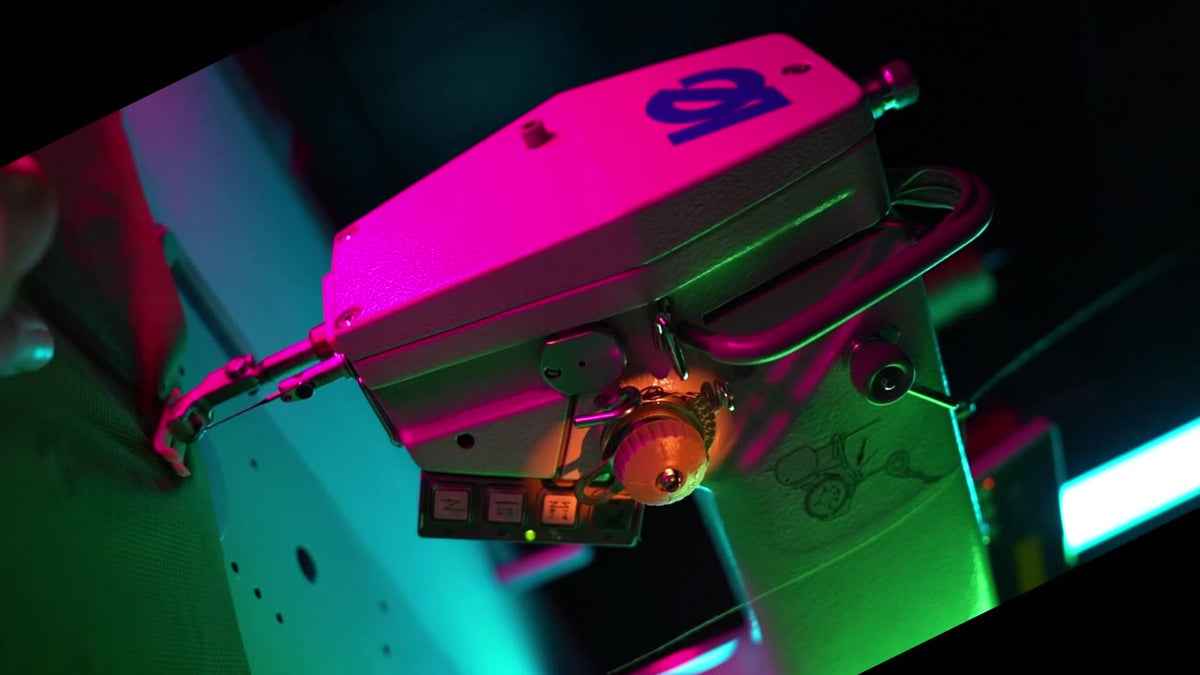
In 2004, one thing became clear: our highly technical products demand time, and zero tolerance for error. That could never be entrusted to a third party.
So we created our own workshop. In 2005, Valandré opened a 100% self-sufficient production unit in a country with recognised textile expertise: Tunisia. A bet made in the spirit of Maurice Barrard and André Vandeputte: never to delegate what matters most.
Twenty years later, that bet has become a family. Each Valandré bag takes around 6 hours of work and is made by hands we know by name. Some of our sewing machinists have been making our bags for 20 years, a loyalty that is our best guarantee of quality.

The aftercare service
A Valandré product is not designed to be replaced. It is designed to last, and to be repaired when necessary.
Care, washing, repair, refill: we look after every Valandré product, whatever its year of manufacture, with the same techniques and the same materials as those used in production. A zip, a seam, a tear, a compartment to refill: every job is done by hand, one item at a time.
A down refill extends a bag's life by another 10, 15, 20 years. We reopen the compartments, add goose or duck down to match the original fill, and the bag is ready to go again.
Service available for Valandré products only · Average turnaround 21 days · Quote by email before any work