
Our story

Founded in 1979 in the heart of the Aude Pyrenees, Valandré specialises in sleeping bags, down jackets and expedition down suits for the high mountains. It is the story of an obsession with thermal insulation, born of a failure on K2 and championed for nearly 50 years by the greatest Himalayan climbers.

Birth

1979–1991 – The invention of H-box baffles

In 1979, 14 French climbers set off for K2 with 1,200 porters to haul nearly 300 kg of gear up to the high-altitude camps. They would not reach the summit. The failure had nothing to do with their ability, and everything to do with their load.

On his return, Maurice Barrard, president of the Himalayan section of the Club Alpin Français (French Alpine Club), was convinced that everything had to be rethought: the future of Himalayan climbing lay in alpine style – light, fast, without supplementary oxygen. He met André Vandeputte, a textile engineer and climber.

With no funding and nothing but a sewing machine, in a garage in Nîmes, the two men got to work. They came up with a compartment system using H-box (box-wall) baffles, a clean break from the sewn-through construction used by every brand at the time. The compartments were vertical, the down was no longer crushed, and the insulation improved. It was the first time such a system had been used on high-mountain gear.

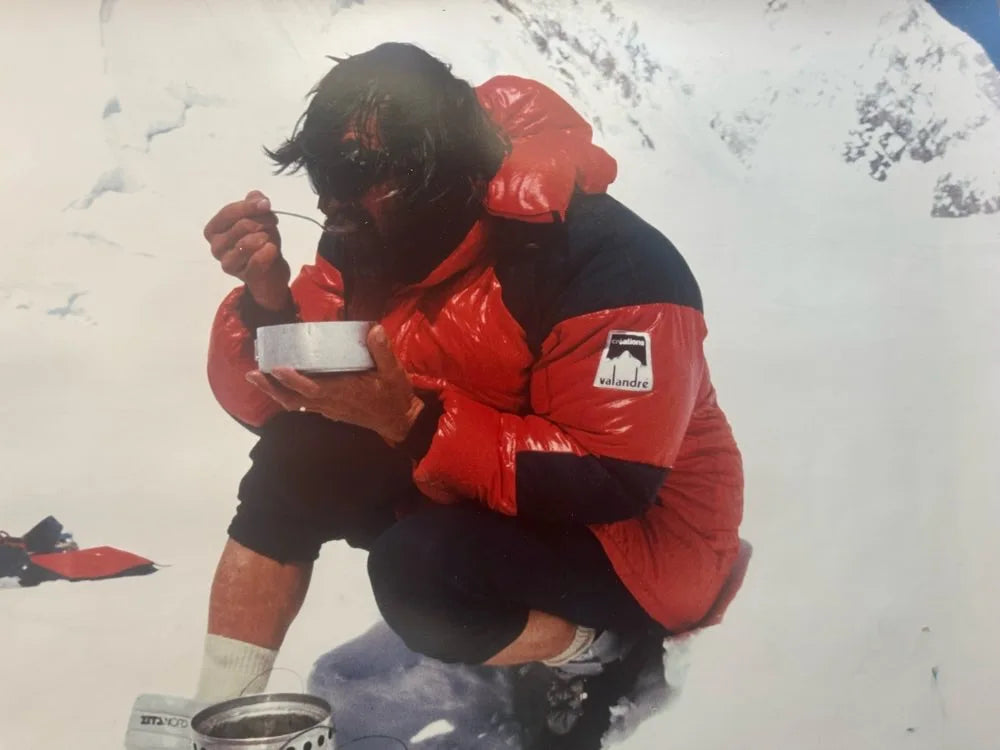
The first prototypes were one-offs, each designed for one climber, one summit, one kind of cold. They passed from hand to hand among the Chamonix climbing community. Word of mouth did the rest. In 1983, the workshop moved to Belcaire, in the heart of the Aude Pyrenees. Valandré: André's valley.

Then the mountains took back what they had given. In 1986, André was killed by lightning on the Pyrenean plateau. That same year, Maurice and Liliane Barrard disappeared on K2. In 1988, the company was declared bankrupt. A relaunch got under way in 1989, but by 1991 it was clear that one man's passion was not enough. It was a commercial and financial failure.

Rebirth

1992–2006 – Niels Henrik Friisbøl and the rebuilding of a method

In Chamonix, at Snell Sport, a young Dane watched the climbers coming in for their gear. Niels Henrik Friisbøl knew Valandré products through the climbers who had taken them to the summit. A climber himself, he knew what they were worth.

“I quickly realised what was at stake. It had to be protected.”

In 1992, he bought the company, then in debt, for a nominal one franc.

The business had been bled dry. It had to move from craft to industrial production, overhaul its range and rebuild a method. Niels Henrik did not like managing; he liked designing: drawing a bag, working out why a seam creates a cold spot, looking for the cut that would hold the down in place. From 1994 onwards, two new models came out every year.

In 1997, he developed the differential cut, which radically changed the way a sleeping bag is built: the two fabrics enclosing the down were no longer cut identically, but to different circumferences (narrower on the inside than on the outside), trapping the down and giving more warmth. The La Fayette was the first to use this new construction, which came with an entirely new baffle system: the baffles, until then straight and vertical, became arched to follow the tubular shape of the bag.

At Valandré, everything starts in the field. A bag that held up for a night at 7,500 metres, a down jacket brought back from an 8,000-metre peak bearing the marks of the cold, a detail a climber reported back after an expedition: all of it feeds into the next generation. There is no laboratory, no simulation. There are people who use the gear, and a workshop that listens.

The mid-2000s were more difficult. In 2004–2005, the brand went through a crisis. Production in France was no longer economically viable, and garment manufacturing was relocated to Monastir, in Tunisia. Rather than hand it over to a subcontractor, the brand set up its own workshop there: manufacturing stayed in-house.

In the midst of this crisis, Niels Henrik kept on designing. In 2004, he developed a third technical principle: the anatomical cut. Each baffle was now cut individually to fit a precise part of the body, with between 30 and 50 unique pieces per product. The Shocking Blue was the first bag to feature it.

A new face

2006–2020 – Recognition and expansion

In 2006, the brand changed its look: the blue logo with its mountains gave way to orange. A visual sign of a turning point that was playing out, first and foremost, in the products.

The anatomical cut principle was in place; it now had to be applied to the whole range, one bag at a time. The Bloody Mary led the way in 2009 and, that same year, won gold at the Outdoor Industry Award in Friedrichshafen – the first international recognition for an anatomically cut Valandré bag.

The Mirage, the Odin and the Thor completed the line-up in the years that followed. In 2015, it was the Odin's turn to be recognised, with an Editor's Choice at the Outdoor Industry Award. The following year, the Chill Out range made the switch, and the La Fayette, in its new version with anatomical tubular baffles, won the Desnivel Prize in Spain.

At the time, down clothing followed a different logic: straight baffles, with fabric deliberately left under the arms to preserve freedom of movement without straining the seams. It was this construction that earned the Immelman jacket a gold award at the OutDoor Industry Award in Friedrichshafen in 2011, the Bifrost its award in 2013, and the Immelman G2 a further gold award in 2014.

The turning point came in 2018. The Troll became the first Valandré down jacket built entirely with an anatomical cut, and won the OutDoor Industry Award that same year.

From then on, a new piece of gear with anatomical baffles came out almost every year: gilets, down jackets, two-piece suits, mitts, booties. Meanwhile, the brand expanded into Europe, Korea and Japan.

More than 20 years after it was first developed, the anatomical cut is still at the forefront of sleeping bag design, and of down gear in general.